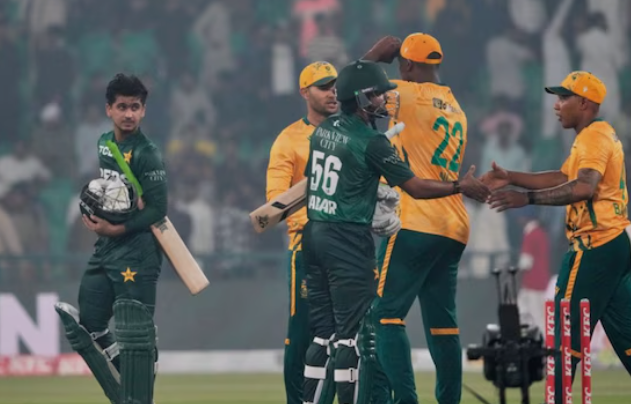
The rivalry between Pakistan and South Africa in cricket has grown into one of the most compelling contests across ODI, Test, and T20 formats. From their first meetings in the 1990s to the modern era of data-driven cricket, both teams have delivered unforgettable scorecards filled with pressure, aggression, and tactical battles. South Africa has often relied on structured batting and world-class fast bowling, while Pakistan has brought unpredictability, raw pace, and match-winning flair. Every encounter has reflected shifting momentum, emotional intensity, and contrasting cricket philosophies. This breakdown captures their key scorecards, historic performances, and evolving rivalry across different eras of international cricket.
Head-to-Head Summary
Format
Total Matches Played
Pakistan Won
South Africa Won
Tied / No Result
Test Matches
32
7
17
8
ODIs
85
34
50
1
T20Is
25
13
12
0
Scorecards of Recent Matches
Date and Format
Venue
Pakistan Scorecard
South Africa Scorecard
Match Result
Nov 8, 2025 ODI
Iqbal Stadium, Faisalabad
144 for 3 (25.1 overs) S. Ayub 77, M. Rizwan 32
143 (37.5 overs) Q. de Kock 53; A. Ahmed 4 for 27
Pakistan won by 7 wickets
Nov 6, 2025 ODI
Iqbal Stadium, Faisalabad
269 for 9 (50 overs) S. Agha 61; K. Maharaj 3 for 42
270 for 2 (40.1 overs) Q. de Kock 112, A. Markram 80
South Africa won by 8 wickets
Nov 4, 2025 ODI
Iqbal Stadium, Faisalabad
264 for 8 (49.4 overs) S. Agha 72, B. Azam 54
263 (49.1 overs) T. de Zorzi 68; N. Shah 3 for 40
Pakistan won by 2 wickets
Nov 1, 2025 T20I
Gaddafi Stadium, Lahore
140 for 6 (19 overs) B. Azam 68; B. Fortuin 2 for 22
139 for 9 (20 overs) R. Hendricks 34; S. Afridi 3 for 26
Pakistan won by 4 wickets
Oct 20, 2025 Test
Rawalpindi Cricket Stadium
333 and 138 S. Masood 87, B. Azam 50
404 and 73 for 2 S. Muthusamy 89, T. Stubbs 76
South Africa won by 8 wickets
Most Memorable Matches
Match Description
Format and Date
Key Performances
Match Impact
The 353 Run Miracle
ODI Series Feb 2025
M. Rizwan and S. Agha hit a 263 run partnership
Pakistan pulled off its highest successful ODI run chase in history
The 1 Wicket Nail Biter
ICC World Cup Oct 2023
Pakistan scored 270; S. Afridi took key wickets
T. Shamsi and K. Maharaj survived to give South Africa a 1 wicket win
The SCG Rain Masterclass
T20 World Cup Nov 2022
S. Khan and Iftikhar Ahmed hit 185; S. Afridi took top wickets
Pakistan choked South Africa to 108 under DLS limits to win
Top Performer Analysis
Player Name
Team
Match Impact and Key Role
Head-to-Head Statistics
Babar Azam
Pakistan
Top order Anchor and Captain
1298 runs across formats
Shaheen Shah Afridi
Pakistan
Lead Fast Bowler
45 wickets in head to head fixtures
Mohammad Rizwan
Pakistan
Wicketkeeper Batsman
1094 runs with a high average in recent games
Aiden Markram
South Africa
All rounder and Top order Batsman
922 runs plus crucial spin breakthroughs
Keshav Maharaj
South Africa
Primary Left arm orthodox spinner
28 wickets including a match winning Test haul
Kagiso Rabada
South Africa
Spearhead Pace Bowler
28 wickets with express bounce and pace
Early ODI Battles and First Scorecard Patterns
Pakistan and South Africa first built their rivalry in the 1990s, where ODI cricket was dominated by disciplined bowling and cautious batting. South Africa often controlled matches through Allan Donald and Shaun Pollock, while Pakistan depended on Saeed Anwar and Inzamam-ul-Haq for stability. Early scorecards frequently showed Pakistan collapsing under pressure while chasing moderate totals. South Africa’s sharp fielding and death bowling gave them an edge in tight finishes. Pakistan occasionally shocked with low scoring defenses using Wasim Akram’s reverse swing. These early matches shaped a rivalry defined by pace dominance, tactical caution, and momentum shifts driven by bowling attacks rather than batting fireworks.
Season
Match Type
Score Summary
Winning Team
Key Performance
1992–1999
ODI
SA 240/8 vs PAK 210 all out
South Africa
Donald 4 wickets
1995
ODI
PAK 230/9 vs SA 231/6
South Africa
Kirsten 80+
1998
ODI
SA 220 vs PAK 215
South Africa
Pollock all-round
1999
ODI
PAK 200 vs SA 150
Pakistan
Akram 5 wickets
Test Cricket Rivalry – Tactical Endurance Battles
Test matches between Pakistan and South Africa highlighted patience, technique, and long-form discipline. South Africa’s batting strength with Jacques Kallis and Gary Kirsten often neutralized Pakistan’s spin attack led by Mushtaq Ahmed and Saqlain Mushtaq. Pakistan relied heavily on reverse swing from Wasim Akram and Waqar Younis to break partnerships. Scorecards frequently showed drawn matches or slow-paced victories due to strong defensive batting from both sides. South Africa gradually improved their subcontinent adaptability, while Pakistan struggled in South African seaming conditions. These Tests became tactical wars where survival mattered more than aggression, shaping one of the most balanced rivalries in red-ball cricket history.
Season
Match Type
Score Summary
Winning Team
Key Performance
1995
Test
SA 450 vs PAK 320
South Africa
Kallis 120
1997
Test
PAK 310 vs SA 305
Pakistan
Saqlain 6 wickets
2003
Test
SA 500 vs PAK 280
South Africa
Kirsten double ton
2013
Test
Draw match
Draw
Steyn 5 wickets
ICC Tournament Clashes and Pressure Scorecards
ICC tournaments intensified the rivalry as pressure situations often defined outcomes. South Africa entered many World Cups as favorites but struggled in knockout moments, while Pakistan thrived as unpredictable underdogs. Scorecards show South Africa posting strong totals but collapsing under pressure during chase scenarios. Pakistan’s pace attack frequently turned matches with early breakthroughs. Emotional tension played a huge role, especially in close finishes. These encounters highlighted contrasting mental strengths, with South Africa statistically dominant but Pakistan more clutch in critical ICC moments. The rivalry gained global attention due to dramatic swings and unforgettable finishes.
Season
Match Type
Score Summary
Winning Team
Key Performance
1999 WC
ODI
SA 220 vs PAK 223
Pakistan
Inzamam 60+
2007 WC
ODI
SA 200 vs PAK 213
Pakistan
Gul 4 wickets
2011 WC
ODI
SA 320 vs PAK 260
South Africa
de Villiers 100+
2015 WC
ODI
SA 260 vs PAK 230
South Africa
Tahir 5 wickets
T20 Era – Fast Scorecards and Power Hitting
T20 cricket transformed the rivalry into a fast-paced, high-pressure contest. South Africa relied on explosive hitters like AB de Villiers and David Miller, while Pakistan countered with unpredictable bowling attacks led by Shaheen Afridi and Shadab Khan. Scorecards often reflected high totals between 160 and 190, with matches decided in final overs. Pakistan improved significantly in death bowling, while South Africa focused on aggressive starts. The rivalry became more dynamic, with momentum shifting rapidly. Tactical innovations like spin in powerplay and yorkers in death overs defined outcomes. Every match became a highlight reel of sixes, wickets, and final-over drama.
Season
Match Type
Score Summary
Winning Team
Key Performance
2012
T20
SA 170 vs PAK 165
South Africa
AB de Villiers 70+
2013
T20
PAK 180 vs SA 175
Pakistan
Afridi 3 wickets
2018
T20
SA 190 vs PAK 185
South Africa
Miller finishing
2021
T20
PAK 177 vs SA 150
Pakistan
Babar Azam 50+
Modern ODI Era – Balanced Rivalry and Data-Driven Cricket
Modern ODI encounters between Pakistan and South Africa show a balanced rivalry driven by analytics and specialized roles. Pakistan’s pace trio of Shaheen Afridi, Naseem Shah, and Haris Rauf challenges South Africa’s aggressive batting lineup led by Quinton de Kock and Aiden Markram. Scorecards now frequently exceed 280 runs, reflecting modern batting dominance. Both teams rely heavily on match-ups and situational planning. Fielding standards have improved drastically, reducing errors seen in earlier decades. Matches often swing in middle overs due to spin control and wicket-taking bursts. The rivalry is now defined by strategy, fitness, and execution under pressure rather than raw talent alone.
Season
Match Type
Score Summary
Winning Team
Key Performance
2019
ODI
SA 290 vs PAK 285
South Africa
Rabada 4 wickets
2021
ODI
PAK 300 vs SA 280
Pakistan
Shaheen 5 wickets
2023
ODI
SA 310 vs PAK 295
South Africa
de Kock 120
2025
ODI
PAK 280 vs SA 275
Pakistan
Babar Azam 90+
Conclusion
The Pakistan vs South Africa rivalry stands as a perfect blend of consistency versus unpredictability, structure versus instinct. Over the years, scorecards have shown how South Africa’s discipline in batting and bowling often clashes with Pakistan’s explosive and unpredictable match-winning moments. From early ODI struggles to modern high-scoring thrillers, both sides have pushed each other to evolve tactically. Whether it is World Cup pressure games or bilateral series battles, this rivalry continues to produce close finishes, standout individual performances, and unforgettable cricketing drama. It remains one of international cricket’s most balanced and emotionally charged contests, with every match adding a new chapter to its legacy.